
Between October 5th and 8th, Indigenous Climate Action joined Indigenous peoples from across Turtle Island in Hamilton, Ontario, where the Assembly of First Nations (AFN) hosted its 4th National Climate Gathering, “Strengthening First Nations Climate Leadership: Braiding Relationships, Knowledge Systems, and Inherent Responsibilities.” The gathering took place on the traditional territories of the Mississauga and Haudenosaunee Nations, within the lands protected by the Dish with One Spoon Wampum Agreement. It brought together First Nations leaders and citizens, environmental specialists, academics, environmental non-governmental organizations, and government officials to discuss Indigenous climate leadership and responsibilities.
Events like these matter because, as Climate Curriculum Developer Michelle Yanes put it, "while the formal program focused on climate leadership, knowledge systems, and First Nations-led solutions, some of the most meaningful outcomes came through the informal conversations, connections, and relationship-building that happened throughout the three days." What made the gathering beautiful was the opportunity for Indigenous peoples from different communities to come together through genuine, reciprocal exchange. These conversations created space to share what each community does well in its relationship with the environment, identify where support is needed, and learn from one another’s approaches to addressing climate change.
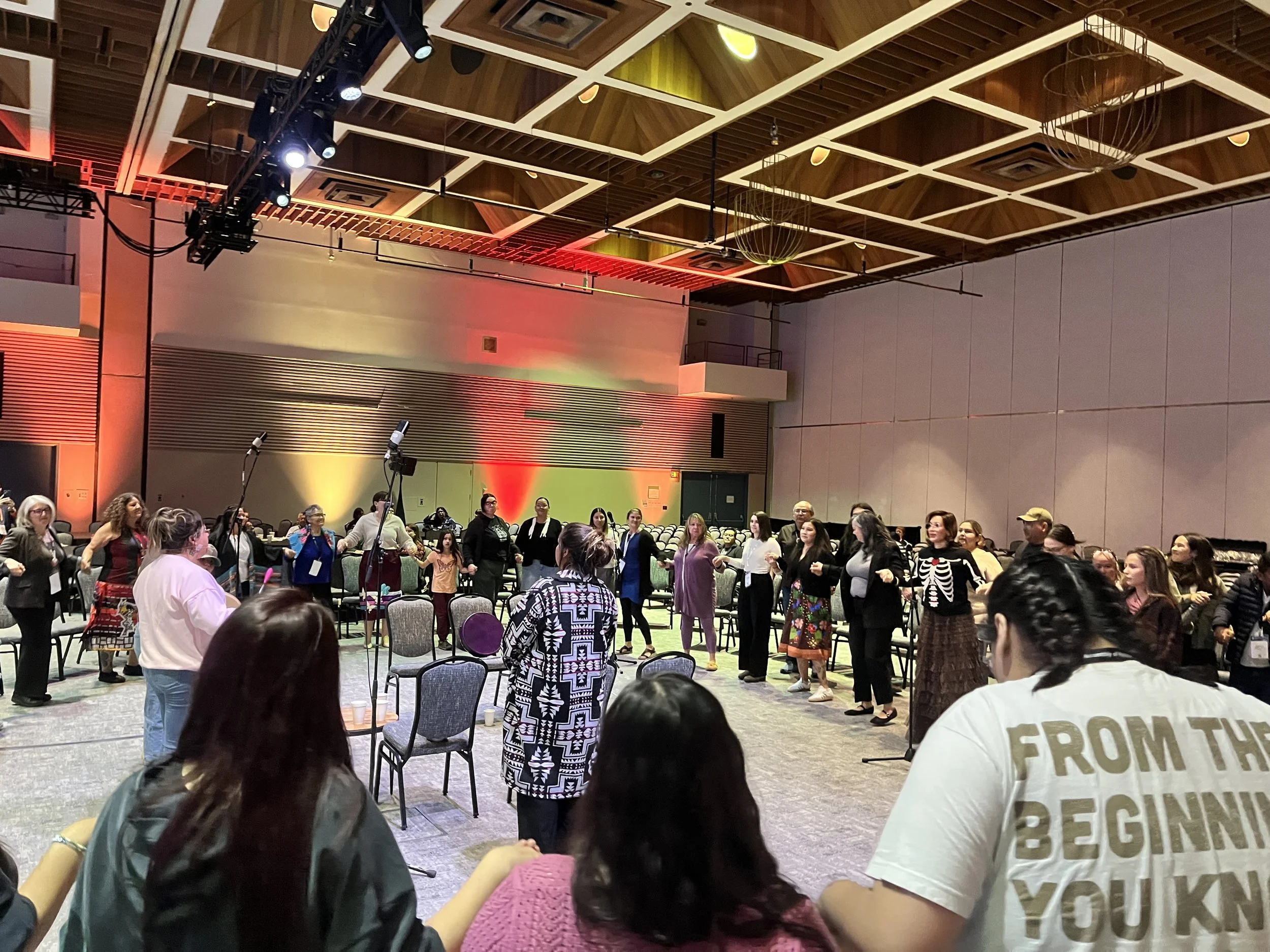
Indigenous peoples from Colombia, Peru, Bolivia, & Guatemala joined Indigenous peoples from Turtle Island for a round dance.
The agenda created valuable opportunities to connect with youth and community members, learn about ongoing organizing efforts, and better understand how climate action intersects with broader community priorities. Over the three days, these conversations helped strengthen relationships that can extend beyond the gathering and create opportunities for future partnerships, including land-based gatherings, community events, and climate education and engagement initiatives.
According to Yanes, "there was a strong sense that climate work cannot be separated from the broader political and social realities facing communities. Conversations connected climate action with land, water, sovereignty, rights, community wellbeing, and protection of future generations."
The gathering also provided an opportunity to connect with people involved in ongoing campaigns and organizing around Bills C-5 and C-39. These conversations offered insight into how the legislation is shaping community priorities and climate advocacy. Bill C-39, in particular, has become a significant concern because of its proposed approach to fast-tracking major projects under the broad and non-transparent justification of “national interest.” This raises concerns about the protection of Indigenous rights, the principle of Free, Prior and Informed consent under the United Nations Declaration of Indigenous Peoples, and the integrity of environmental assessments.
Alongside these opportunities for connection and collaboration, the gathering also surfaced important tensions around economic development, Indigenous sovereignty, and our collective responsibilities to the land. These legislative concerns were closely connected to one of the main controversies at the gathering: how should Indigenous peoples approach economic sovereignty without compromising their responsibilities to the environment? Some representatives expressed that First Nations could exercise their consultation and treaty rights to influence and benefit from extractive industries, particularly in the context of the Canada Strong Act, rather than trying to dismantle existing systems entirely. By participating in these industries, communities could strengthen their economies and become less reliant on federal funding.
Discussions around mining, oil extraction, and small modular nuclear reactors brought this tension into focus. While this approach may offer economic opportunities in the near future, it raises a deeper question about what communities risk sacrificing in the process and whether they would be compromising their values in pursuit of revenue. Are communities truly free if they remain intimidated by outside political rhetoric and economic interests? And what does economic sovereignty mean if the land and waters can no longer sustain the next seven generations?
Ultimately, Indigenous peoples understand that our relationship with the land is not one of ownership, but of belonging and responsibility. When land is treated as a resource to be exploited, it becomes easier for high-emission industrial sectors to justify the destruction of the ecosystems and communities that depend on it. This is why conversations about economic sovereignty and participation in extractive industries require careful consideration of what is at stake. While these industries may offer financial gain, we must ask whether those benefits come at the expense of the lands, waters, and values Indigenous peoples have worked so hard to protect.
Moreover, it is crucial to be mindful of the risk of Indigenous leadership being tokenized to legitimize harmful industries, particularly as Indigenous leadership are often recognized as environmental leaders. The idea of full economic autonomy should strengthen our communities without compromising our responsibilities to future generations.
Profit alone is an insufficient measure of human rights and quality of life. Any meaningful understanding of economic sovereignty must also account for the right to a clean and healthy environment, and for Indigenous peoples’ ability to continue practicing our cultures, ceremonies, and hunting traditions. Economic development cannot be separated from the lands, waters and relationships that sustain us. If the pursuit of economic independence comes at the cost of these responsibilities, we must ask what kind of sovereignty is being achieved, and for whom.
Sobre o autor
Destiny Whitebean, whose Kanien’kehá name is Katsitsatekanoniahkhwa, meaning “Dancing Flower,” is a Wolf Clan member of the Kanien’kehá (Mohawk) Nation from Kahnawà. She recently graduated from Syracuse University with bachelor’s degrees in Political Science and Communications and Rhetorical Studies, with a minor in Native American Studies. Destiny is currently an Explore & Blossom Intern at Indigenous Climate Action.
